
Machakos University and Riga Technical University Explore New Areas of International Institutional Collaboration
- Posted by admin
- Posted in University News
Machakos University has strengthened its internationalization agenda following an engagement with Riga Technical University (RTU), Latvia, Business School, to explore expanded opportunities for academic, research and institutional collaboration.
The engagement, held at the Deputy-Vice Chancellor (Research, Innovation & Linkages) Boardroom on 22nd September 2026, brought together senior University officials and Dr. Ineta Kristovska from Riga Business School, RTU. The visit formed part of the University’s participation in the Erasmus+ International Mobility Programme at Riga Technical University, through which Machakos University students and staff travel to RTU for exchange programmes, coordinated by Prof. Stanley Makindi, the Erasmus+ Programme Coordinator, Machakos University. His coordination provided an important platform for strengthening the relationship between the two institutions and facilitating further discussions on broader areas of academic and institutional cooperation.
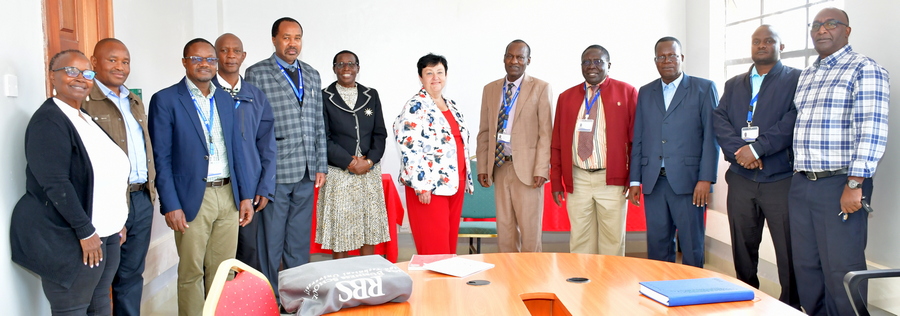
The meeting was chaired by Prof. David Mulwa, Registrar, RIL; and brought together Prof. Charles Ombuki, Director, Research, Innovation and Technology Transfer (RITT); Dr. Michael Musembi, Head of Collaborations and Partnerships; Dr. Ishmael Muasa, Chair of Department, Business and Finance; Prof. Robert Arasa, Dean, School of Business, Economics, Hospitality and Tourism Management; Dr. Adam Shisia; Dr. Margaret Musyoka and Mr. Shadrack Muvea, Senior Administrative Assistant, RIL. The engagement explored opportunities for expanding collaboration in Business education, applied research, quality assurance, academic mobility and postgraduate training.
Dr. Kristovska expressed RTU’s interest in exploring the joint development and delivery of Bachelor of Business Administration (BBA) and Master of Business Administration (MBA) programmes, as well as the joint development and writing of academic case studies. The proposed collaboration would provide opportunities for sharing expertise, strengthening curriculum development and exposing students and staff to international academic practices.
The two institutions also discussed student and staff exchange programmes, with emphasis on harmonizing academic programmes and establishing appropriate mechanisms for credit recognition. This would enable students participating in mobility programmes to benefit from international exposure without unnecessary loss of academic time. Another key area of discussion was research collaboration. The meeting noted RTU’s strong emphasis on applied and practice-oriented research, particularly research that connects technology with business and addresses real-world challenges. The two institutions identified opportunities to share experiences and develop joint research initiatives with practical applications and impact.
The possibility of RTU academics supporting the supervision of Master’s and PhD students at Machakos University was also discussed. Such collaboration would contribute to strengthening postgraduate research capacity and enhancing the internationalization of the University’s research programmes. The meeting further explored opportunities for Machakos University to benefit from RTU’s wider international academic networks, including its collaborations with leading universities in the United States and the European Union. RTU’s experience in open and distance learning was also identified as an area from which Machakos University could draw valuable lessons in expanding flexible learning opportunities.
The two institutions further discussed sharing good practices in quality assurance and accreditation, as well as opportunities for strengthening Machakos University’s visibility within RTU’s network of African institutional partners. The engagement marks another step in Machakos University’s continued efforts to expand international academic networks, promote student and staff international mobility, strengthen applied research and foster partnerships that translate knowledge and innovation into tangible institutional and societal impact.